I’ve always been obsessed with my family background and history. I’m the grandson of two Holocaust survivors on my father’s side, and growing up in a Jewish community meant learning a lot about what Jewish people went through – and what they overcame.
I was especially close with my paternal grandmother, Gita Edelsburg, who I called Savta – grandmother in Hebrew. She grew up in Vilkaviškis, Lithuania, and survived the Holocaust after being imprisoned in the Kovno Ghetto. While being marched toward Poland, she was saved by a Polish family. Amazingly, I’m still in touch with that family today.
My grandmother eventually made her way to the United States, where my father was born, and later moved to Israel. But Lithuania remained present in our family in small ways.
Every time I visited her as a kid, from the time I was four until she passed away, she would make Lithuanian food for us. I can still remember the taste, the look and the feel of those meals. We even made a family cookbook with her recipes.
Why Lithuania?
My grandmother’s relationship with Lithuania was complicated. She had been deported simply for being Jewish, and after the war Lithuania was a very difficult place for her to reconcile with. In fact, she often claimed she was Polish, even though she had actually been born in Lithuania.
I’ll admit that if my grandmother knew today that I had gone through the process of restoring Lithuanian citizenship, she probably would have misunderstood it – and might not necessarily have agreed with it.
But as the third generation, I have a very different perspective.
For me, as a Jewish person living today, connecting with our roots is extremely important. In some ways, becoming a Lithuanian citizen is my way of saying that the Nazis were not successful. My family is still here. And now, generations later, we can rejoin the Lithuanian community.
I already had Polish citizenship through my grandfather, so I wasn’t doing this simply to gain access to the European Union. I genuinely wanted that connection with Lithuania.
And I wanted it for my children.
I had also been following the work of Ralph Salinger in Israel, whose family, like mine, came from Vilkaviškis. Through his website dedicated to the Jewish heritage of Vilkaviškis, he has collected photographs and stories and documented his visits there. His work inspired me to look more deeply into my own Lithuanian roots.
Most Holocaust survivors are now no longer with us. I had the incredible privilege of knowing my grandmother very well, but my children won’t have that same experience. Lithuanian citizenship gives them a direct connection to their past – and hopefully a reason to explore Lithuania, learn its history and understand where their family came from.
My daughter even has Gita as her Hebrew name, after my grandmother. Family history has always been very real to me.
Then the real detective work began
When I started researching Lithuanian citizenship, I found IN IURE online. They stood out to me because of their reputation and because they were willing to take on the case on a contingency basis. There was very little financial risk for me: if we weren’t successful, I wouldn’t pay the agreed success fee.
That mattered because this was definitely not a straightforward case.
The whole process ended up taking more than three years. Looking back, I would describe it as fun, challenging, exciting, interesting – and requiring a LOT of patience.
First came all the official documents and apostilles, which can be a lengthy process. I was lucky to find E.Z.T.R Corp, an organization that helps Jewish and non-Jewish families around the world with documentation and services like this.
Then came the waiting and, honestly, some pretty amazing detective work.
IN IURE found Lithuanian voting records and other documents about my family that we had never been able to find ourselves.
But the biggest challenge was reconstructing my grandmother’s Lithuanian birth record.
Her documents contained major discrepancies, including a different birth date and references to Poland rather than Lithuania. But there was a reason for this. After the war, she wanted to remain with the friends she had survived with in Poland, and at the time the largest displaced persons camp was in Łódź. So she put on her papers that she was Polish because she didn’t want to be deported back to Lithuania.
In the end, that decision became part of our family story too. She stayed in Poland, met my grandfather – and, as I like to say, here I am.
So we had to prove who she really was, where she had been born and why the information in her later documents was different.
That took us deep into our family history, including records connected to her first husband. She had lost both her husband and a child during the Holocaust before somehow finding the strength to rebuild her life and family.
IN IURE told me they had never dealt with a case involving such a large discrepancy in a person’s documented birth date.
And yet, eventually, we proved it.
That was a huge moment for me.
I felt like I was on a mission to reclaim my family’s history.
Three years – and a lot of questions
Throughout the process, Dainius Ambrazaitis and the IN IURE team were incredibly persistent. Lianna Grigoryan was my main contact and somehow remained patient with all my questions – even when they were probably a little annoying or repetitive.
There were WhatsApp calls, easy scheduling, constant questions from me, and long periods when there simply wasn’t anything to do but wait.
What impressed me most was the tenacity.
This was never a 100% certain case. I had actually been told elsewhere that I probably wouldn’t succeed because we simply didn’t have enough documentation.
But IN IURE kept going.
They found documents about my family we had never seen before, worked through the inconsistencies and stayed committed to making the case.
After more than three years, they did.
Then I got the email
I was ecstatic when the email from Dainius finally arrived. I couldn’t believe the process had actually come to an end.
And it wasn’t just my citizenship. My children now had this connection too.
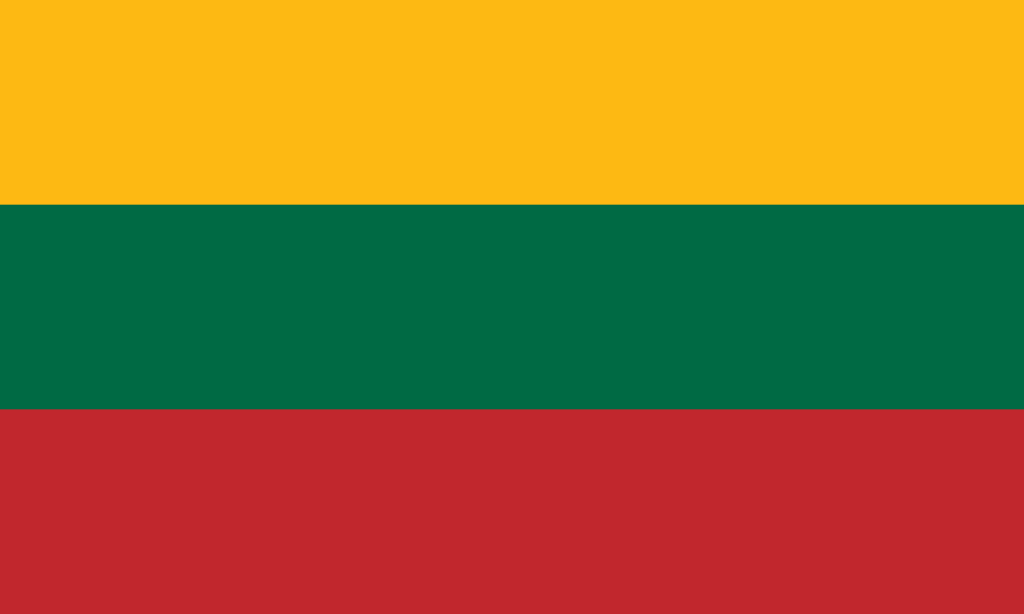
We quickly scheduled an appointment at the Lithuanian Consulate in New York, and my wife surprised us by bringing Lithuanian flags. The kids loved them – especially the colors.
The Consulate made the whole experience incredibly welcoming. They gave the children books about Lithuania and were remarkably patient with our twin six-year-olds and three-year-old running around the office!
Suddenly something that had begun with my grandmother’s story in Vilkaviškis, survived the Holocaust, crossed continents and lived on through family memories and recipes had become tangible for another generation of our family.
What Lithuanian citizenship means to me today
It means opportunity and family connection.
Of course, my children now have the opportunities that come with EU citizenship and freedom of movement. But for me, it goes much deeper than that.
It closes a chapter in our family history while opening another one.
Jewish families outside Europe understandably have complicated relationships with the places their families came from because of what happened there. I would like to be part of building a different kind of relationship today – one based on learning, connection and new relationships.
I’m excited to bring my children to Lithuania in the next year or two, show them where their family came from and keep that connection alive.
And I’ve already noticed that New York City doesn’t seem to have a dedicated Lithuanian restaurant.
Maybe one day I can help change that too.
My advice if you’re just starting
Have patience. Stay organized. Listen carefully to what the IN IURE team asks you for – they are extremely detail-oriented – and respond when they need something from you.
And understand that this may be a journey.
There can be delays, setbacks and unexpected turns. Mine took more than three years. Stick with it.
But I would also say: don’t wait.
When your representatives ask you for information, get back to them. Keep the process moving. The world changes, Europe changes, and bureaucratic processes change with it. Requirements can become more complicated, and things that are possible today may take longer or require more tomorrow.
You can’t know what the process will look like a few years from now.
So, if reconnecting with this part of your family history matters to you, start now. The sooner you do it, the better.
Start your journey now
Restoring Lithuanian citizenship is a meaningful step – whether to reconnect with your heritage, access EU opportunities, or secure your family’s future.
Book consultation

